How to Build a B2B Ideal Customer Profile (With a Free Template)
Every good prospect list starts with a clear ideal customer profile. Here is a step-by-step way to build one for a small B2B business, with a template you can copy and a worked example.
 Farrukh R.Founder, Dataverix · 4 min read

KEY TAKEAWAYS
- An ideal customer profile (ICP) describes the type of company that gets the most value from what you sell — and is most valuable to you.
- It is different from a buyer persona, which describes the person you sell to inside that company.
- A useful B2B ICP covers industry, company size, location, business model, trigger signals and exclusions.
- Build it from your best existing customers, keep it to one page and turn it into concrete list criteria.
What is an ideal customer profile?
An ideal customer profile is a short description of the companies that are the best fit for your product or service — the ones that buy quickly, stay longest and get the most value. In B2B, it is written about organisations, not individuals: their industry, size, location, model and the situations that make them need you.
Your ICP is the brief for everything that follows: who goes on your prospect list, what your outreach says and which leads your team prioritises.
Ideal customer profile vs buyer persona
| Ideal customer profile | Buyer persona | |
|---|---|---|
| Describes | The company | The person inside the company |
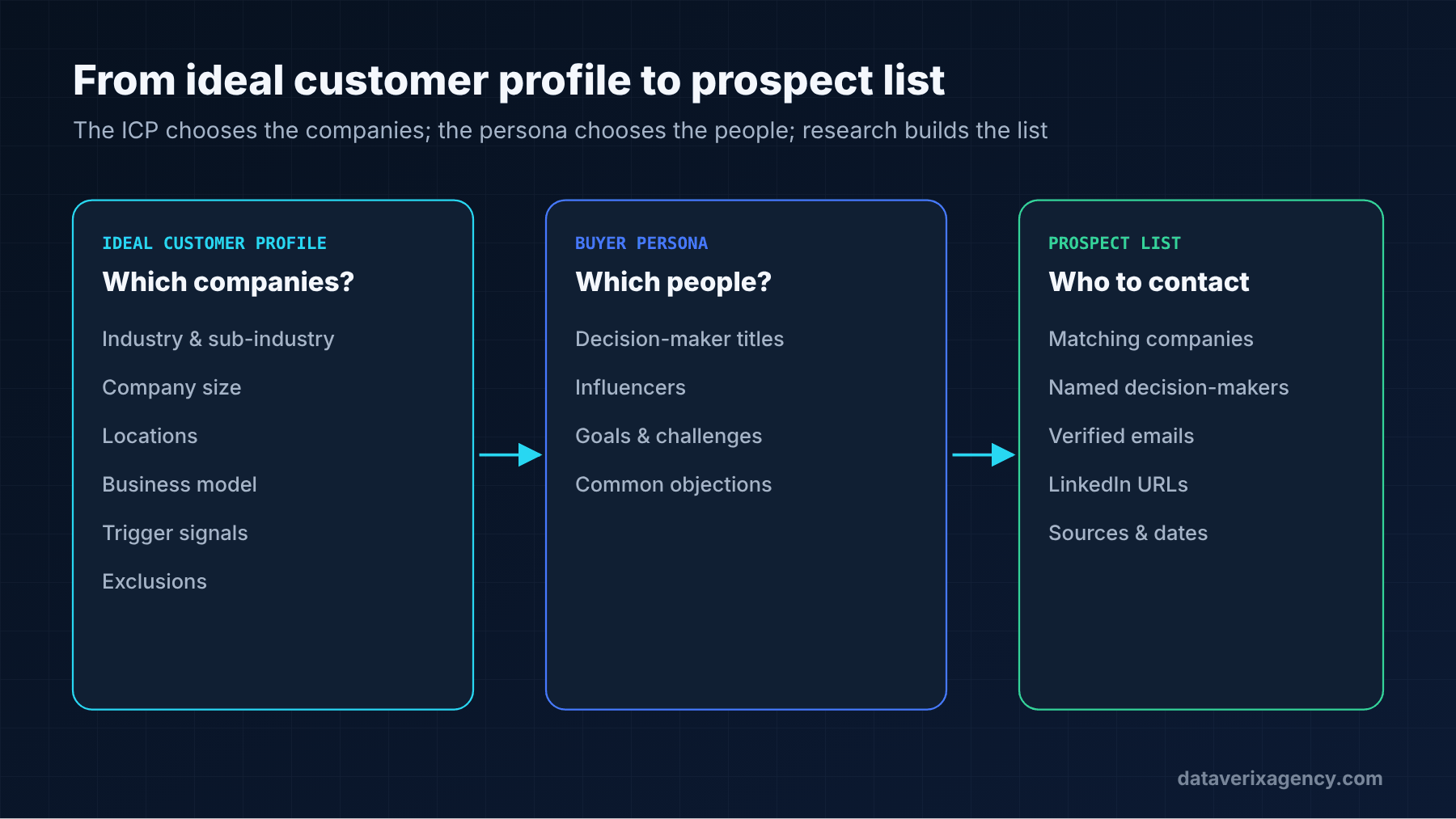
| Typical criteria | Industry, size, location, model, signals | Job title, goals, challenges, objections |
| Used for | Choosing which accounts to target | Choosing who to contact and what to say |
| Example | US dental groups with 3–15 locations | Operations director responsible for supplier contracts |
You need both. The ICP decides which companies go on the list; the persona decides which decision-makers you look for inside them.
How to create your ideal customer profile in 6 steps
Step 1: List your best customers
Pick your five to ten best clients. “Best” means a mix of: easy to win, profitable, happy and likely to buy again or refer you. If you are new, use the clients you wish you had, but plan to revisit the profile after your first wins.
Step 2: Find what they have in common
Write down each company’s industry, employee count, location, years in business, how they make money and why they came to you. Patterns usually appear quickly.
Step 3: Identify the trigger
What was happening when they needed you? Opening a new location, hiring a sales team, launching a product, switching software, a new regulation? Triggers are what turn a good-fit company into a ready-to-buy one.
Step 4: Write down the exclusions
Which companies look right on paper but never work out? Too small to afford you, too large to move quickly, wrong region, a model you can’t serve? Exclusions save as much money as inclusions.
Step 5: Name the people
For each target company, which roles buy, influence and approve? List the exact job titles, plus common variations.
Step 6: Turn it into list criteria
Translate the profile into fields a researcher can actually filter on. “Growing companies” is an opinion; “hiring for two or more sales roles” is a criterion.
Free B2B ideal customer profile template
Copy this into a document and fill it in. Keep it to one page.
| Criterion | Your answer |
|---|---|
| Industries (and sub-industries) | |
| Company size (employees or revenue range) | |
| Locations (countries, states, metro areas) | |
| Business model (B2B, B2C, franchise, multi-location, etc.) | |
| Trigger signals (hiring, expansion, funding, new tools) | |
| Technology or tools they use (if relevant) | |
| Exclusions (who you will not target) | |
| Decision-maker titles | |
| Influencer titles | |
| Fields you need in the final list |
A worked example
Here is a fictional ICP for a US company that sells managed IT services:
- Industries: accounting firms, law firms and architecture practices
- Size: 15–150 employees
- Location: Texas, with priority on Dallas–Fort Worth and Houston
- Model: office-based professional services with client data to protect
- Triggers: opening a new office, hiring an operations manager, recent website relaunch
- Exclusions: firms with an in-house IT department of three or more
- Decision-makers: managing partner, owner, COO, office or operations manager
- Fields: company, website, city, employee range, contact name, title, verified email, LinkedIn URL, source
That profile is specific enough for a researcher to build a clean list from — and specific enough for the sales team to write a relevant first email.
Common ICP mistakes
- Making it too broad. “Small businesses in the US” describes millions of companies.
- Copying a competitor’s ICP. Their best customers aren’t necessarily yours.
- Never updating it. Review it every quarter against who actually bought.
- Skipping exclusions. Without them, lists fill up with companies you can’t serve.
From ICP to prospect list
Once your profile is written, it becomes the brief for your prospect research. That’s exactly how our B2B lead generation service starts: we turn your ICP into list criteria, research companies that match, identify the right people and verify their contact details. See the full process on our how it works page.
If you’re deciding whether to do that research in-house or hand it off, our guide to outsourcing B2B lead generation walks through the options.
Frequently asked questions
What should a B2B ideal customer profile include?
Industry, company size, location, business model, trigger signals, exclusions and the job titles of decision-makers. It should be specific enough that someone else could build a prospect list from it.
How is an ICP different from a target market?
A target market is the broad group you could sell to. An ideal customer profile narrows that down to the companies most likely to buy and succeed with your offer.
How often should I update my ideal customer profile?
Review it every quarter, and whenever your offer or pricing changes. Compare it with the customers you actually won and adjust.
Can a small business have more than one ICP?
Yes, if you serve clearly different segments. Keep each profile separate and build separate lists, so your outreach stays relevant to each one.
Turn your ICP into a verified list
Send us your profile and we’ll build a free sample of matching companies and decision-makers. Request your free data sample.
Cover photo: Vitaly Gariev on Unsplash.
Founder of Dataverix. Farrukh specializes in B2B lead generation, decision-maker research and contact data enrichment, helping US businesses turn fragmented information into structured, sales-ready prospect data.
Meet the founder Upwork profile ↗farrukh@dataverixagency.com