How to Choose a B2B Data Provider in the AI-Agent Era: A Checklist
How to choose a B2B data provider after ZoomInfo's AI-agent push: a 12-point checklist on accuracy, sourcing, compliance, AI access and cost.
 Farrukh R.Founder, Dataverix · 8 min read

KEY TAKEAWAYS
- A B2B data provider is a company that sells or licenses business contact and company records, such as names, job titles, work emails, phone numbers and firmographics, for sales and marketing.
- ZoomInfo’s November 4, 2026 results show the market moving toward AI agents that pull data directly through APIs and the Model Context Protocol (MCP), so data quality problems now spread faster.
- Before signing with any B2B data provider, test a sample of your own target accounts, ask how records are sourced and refreshed, and check opt-out, deliverability and contract terms.
- No vendor’s data is perfect; the right choice is the one that matches your ideal customer profile, documents its sources and fits your budget.
The best way to choose a B2B data provider is to test it against your own ideal customer profile, verify how its records are sourced and refreshed, and confirm the data can be used safely by your team and your AI tools. Brand size and database totals matter far less than whether the records you actually need are accurate.
That test has become more urgent. On November 4, 2026, ZoomInfo reported its third-quarter 2026 financial results, and much of the announcement focused on AI agents: a new multi-agent feature and a “headless” data layer that feeds AI tools through an API and MCP. Below, we explain what that shift means for small and mid-sized US businesses and give you a 12-point checklist for comparing B2B data vendors.
What did ZoomInfo announce on November 4, 2026?
ZoomInfo reported third-quarter revenue of $308.8 million, down 3% year over year, and introduced new AI-agent features for its GTM Studio product. The company also raised its full-year 2026 revenue guidance to $1.2235–$1.2265 billion.
The numbers business buyers should notice
- Net revenue retention of 88%. Net revenue retention (NRR) is the share of last year’s recurring revenue that existing customers still pay after upgrades, downgrades and cancellations. A figure below 100% means that, on balance, existing customers spent less than a year earlier.
- 1,851 customers paying $100,000 or more a year, down 2% year over year, while total spending from that group rose 4%.
- 77% of annual contract value from “upmarket” customers, flat year over year.
The product direction
ZoomInfo launched Agent Teams, which coordinates several specialized AI agents inside GTM Studio, and described GTM.AI as a headless layer that connects its data to AI agents through an API and MCP, with integrations listed for Salesforce, HubSpot, Microsoft, Anthropic, OpenAI and Perplexity. It also announced ISO/IEC 42001:2023 certification for its AI management system.
Why does AI-agent access change how you choose a B2B data provider?
When AI agents read and act on B2B data automatically, a bad record is no longer one wrong email; it can become hundreds of wrong emails, call tasks and CRM updates before anyone notices. That makes accuracy, freshness and clear field definitions more important than ever.
The Model Context Protocol (MCP) is an open standard that lets AI assistants connect to outside software and data sources in a consistent way. For a buyer, MCP or API access is useful only if the underlying records are reliable and each field says how it was verified. We covered the CRM side of this problem in how to prep your CRM for AI sales agents.
Email rules raise the stakes too. Google says senders that deliver close to 5,000 messages a day to personal Gmail accounts are bulk senders, and its email sender guidelines ask all senders to keep spam rates below 0.1% and never reach 0.3%, with SPF, DKIM and DMARC authentication in place. Outdated contacts push bounce rates up and put your sending domain at risk, as we explain in our guide to email bounce rate.
How do you choose a B2B data provider? A 12-point checklist
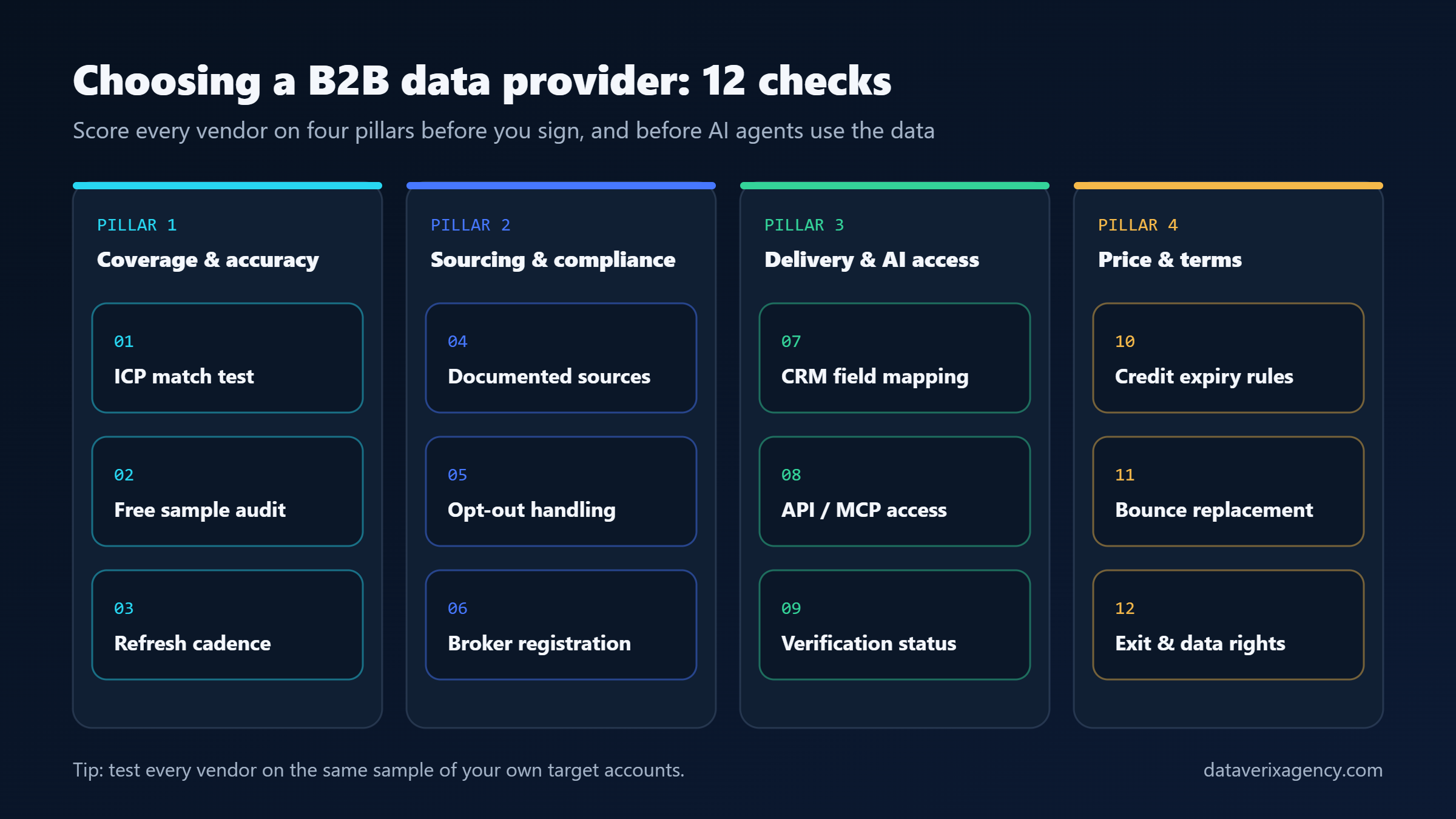
Score every vendor on the same four pillars: coverage and accuracy, sourcing and compliance, delivery and AI access, and price and terms. Use the table below as a working scorecard.
| Pillar | Check | What to ask the vendor |
|---|---|---|
| Coverage & accuracy | 1. ICP match test | How many companies and contacts do you have that match our exact industries, regions, company sizes and job titles? |
| Coverage & accuracy | 2. Free sample audit | Can we test 50–100 records from our own target list before we buy? |
| Coverage & accuracy | 3. Refresh cadence | How often are contacts re-verified, and does each record show a last-verified date? |
| Sourcing & compliance | 4. Documented sources | Where does each field come from, and can you show the source for a sample record? |
| Sourcing & compliance | 5. Opt-out handling | How do you process opt-out and deletion requests, and do suppressions flow through to our exports? |
| Sourcing & compliance | 6. Broker registration | Are you registered as a data broker where required, such as in California? |
| Delivery & AI access | 7. CRM field mapping | Will fields map cleanly into our CRM without creating duplicates? |
| Delivery & AI access | 8. API / MCP access | Can our tools or AI agents query the data, and what are the rate and credit limits? |
| Delivery & AI access | 9. Verification status | Does every email carry a status such as valid, catch-all or unknown? |
| Price & terms | 10. Credit expiry rules | Do unused credits expire, and what happens at renewal? |
| Price & terms | 11. Bounce replacement | Do you replace or credit records that bounce or turn out to be wrong? |
| Price & terms | 12. Exit & data rights | Can we keep exported records if we cancel, and for how long? |
The cheapest per-record price often hides the highest real cost once you count bounces, wasted rep time and cleanup. Our breakdown of the real cost of a cheap B2B database shows how to compare total cost, not sticker price.
How accurate is data from B2B data providers?
Accuracy varies by vendor, industry, region and job level, so the only reliable answer is the one you measure on your own sample. Treat any single headline accuracy figure as a starting point, not a promise.
A simple test works well for small teams:
- Pick 50–100 companies you already know well, including some recent customers.
- Request the same contacts from each vendor you are evaluating.
- Check job titles against company websites and LinkedIn profiles, and run emails through a verification tool.
- Record the share of correct contacts, valid emails and missing fields for each vendor.
If you prefer not to do this in-house, our email finding and verification service can check a vendor sample against fresh, source-backed research.
Do B2B data providers have to follow privacy and email laws?
Yes. B2B contact data is still personal data in many US states, and the email you send with it is still covered by federal law. This section is general information, not legal advice.
Data broker rules
In California, data brokers must register each year and, as of August 1, 2026, process verified deletion requests submitted through the state’s Delete Request and Opt-out Platform (DROP) at least once every 45 days, according to a 2026 overview from Coblentz Patch Duffy & Bass. Penalties for unfulfilled deletion requests can reach $200 per day per request. Ask any vendor how deletions reach the records you have already bought; our article on the California Delete Act and DROP covers this in detail.
Email rules
The FTC’s CAN-SPAM compliance guide states that the law makes no exception for business-to-business email. Opt-outs must be honored within 10 business days, and each violating email can carry a penalty of up to $53,088. A good B2B data provider makes suppression easy; it cannot make your outreach compliant for you.
Should a small business use a database platform or a custom research partner?
A self-serve sales intelligence platform suits teams that need broad, ongoing searches across common industries and titles. A custom research partner suits teams with niche targets, local businesses, hard-to-find decision-makers or an existing list that needs repair.
Many small businesses use both: a platform for volume and a research partner to fill gaps, verify high-value accounts and clean the CRM. For example, B2B data enrichment can complete missing titles, websites and phone numbers on records you already own, and CRM data cleansing removes duplicates and outdated contacts before AI tools start using them.
As of November 2026, AI-agent features, MCP integrations and pricing models among B2B data vendors are changing quickly, so confirm current terms directly with each vendor before you buy.
Related: what ZoomInfo pricing’s shift to credits means for small businesses — usage-based plans change how you should compare data vendors on cost.
Frequently asked questions
What is a B2B data provider?
A B2B data provider is a company that collects, verifies and sells business contact and company information, such as names, job titles, work emails, direct phone numbers, company size and industry. Sales and marketing teams use this data to build prospect lists, enrich CRM records and plan outreach to the right decision-makers.
How much does a B2B data provider cost?
Pricing ranges from free starter plans with limited credits to annual enterprise contracts, and models include per-seat, per-credit and per-record pricing. Compare the total cost of usable records, including bounces, missing fields, expired credits and cleanup time, rather than the advertised price per contact alone.
Can AI agents use B2B data safely?
They can, if the data is accurate, each record shows how and when it was verified, and you set clear rules for what the agent may do with it. Start with a cleaned CRM, limit automated sending volumes, keep suppression lists synced and review agent activity regularly.
How often should B2B contact data be refreshed?
People change jobs and companies change structure constantly, so high-priority accounts should be re-verified before every major campaign, and the full database should be reviewed on a regular schedule. Ask each B2B data provider how often it re-verifies records and whether it shows a last-verified date.
Get a second opinion before you sign
Choosing a B2B data provider is easier when you can see real records for your own market. Tell us who you want to reach, and we will research a sample of verified, source-backed contacts you can compare against any vendor. Request a free data sample.
Cover photo: Jakub Żerdzicki on Unsplash.
Founder of Dataverix. Farrukh specializes in B2B lead generation, decision-maker research and contact data enrichment, helping US businesses turn fragmented information into structured, sales-ready prospect data.
Meet the founder Upwork profile ↗farrukh@dataverixagency.com