ZoomInfo Pricing Shifts to Credits: What Small Businesses Should Know
ZoomInfo pricing is moving from seats to credits. Here is what the Q3 2026 change means for small businesses buying B2B data.
 Farrukh R.Founder, Dataverix · 6 min read

KEY TAKEAWAYS
- ZoomInfo pricing is moving away from a per-seat model: on November 4, 2026, the company said it launched hybrid pricing in Q3 that lets customers convert seats into bulk credit packages.
- Under credit-based pricing, your cost follows how much data you pull and how many tools or AI agents draw on it, not how many people log in.
- ZoomInfo reported that its downmarket (smaller-customer) contract value fell 14% year over year and that it now serves small accounts mainly through a lower-cost digital motion.
- Before renewing or buying any B2B data plan, small businesses should price the cost per usable record, check credit expiry and cap automated usage.
ZoomInfo pricing is shifting from paying per user (“seats”) toward paying for usage (“credits”), and that changes how small businesses should budget for B2B data. On November 4, 2026, ZoomInfo reported its third quarter 2026 results, and on the Q3 2026 earnings call management said new hybrid pricing and packaging launched during the quarter.
We work with US small and mid-sized businesses that buy, build and clean prospect data every week. Below, we explain what changed, what it means for a small sales team, and a practical way to compare any credit-based data plan before you sign.
What did ZoomInfo announce about pricing in Q3 2026?
ZoomInfo said it introduced hybrid pricing and packaging in Q3 2026 and has rolled it out selectively to existing customers so far. Customers can move from seat licenses into larger bulk credit packages.
On the call, CEO Henry Schuck said the company “can shift the seats into a larger bulk credit consumption package.” The CFO added that the stated goal was “to move away from a seat-based model,” while noting that this does not necessarily mean a full consumption model. Management also said some customers renewed flat and some renewed at a lower amount after switching, with more consumption expected over time.
Other numbers that matter to buyers
- Revenue: GAAP revenue was $308.8 million, down 3% year over year, according to the ZoomInfo press release.
- Net revenue retention: 88%, down from 89%, which management attributed mainly to fewer and smaller upsells.
- Upmarket focus: 77% of annual contract value (ACV) now comes from upmarket customers.
- Smaller customers: downmarket ACV declined 14% year over year.
- New access points: more than 10,000 customers have pulled data through an MCP server, a command-line interface and an updated API.
What is credit-based pricing for B2B data?
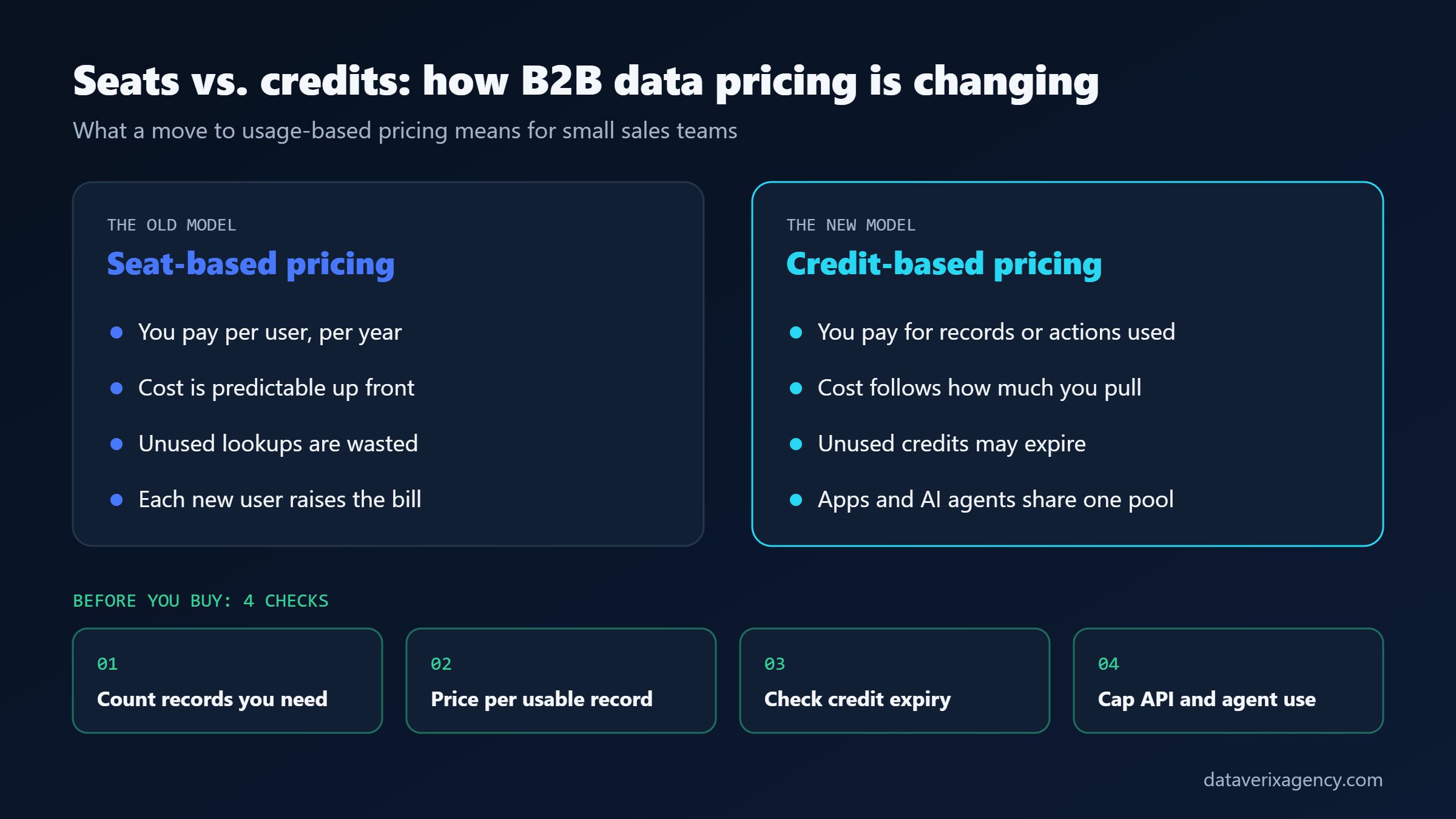
Credit-based pricing is a model where you buy a pool of credits and spend them each time you export a contact, reveal an email or phone number, or run an automated action. Seat-based pricing, by contrast, charges a fixed fee for each named user.
Credits can be fairer for a small team that needs a lot of data but has only one or two users. They can also be riskier: a single misconfigured workflow or AI agent can burn through a year’s budget in days. ZoomInfo’s CFO said data credits are offered on a fixed basis, while AI credits are sized to give first-year customers comfort, which tells you that vendors are still calibrating these packages.
| Factor | Seat-based plan | Credit-based plan |
|---|---|---|
| What you pay for | Each named user | Records, reveals or actions used |
| Budget predictability | High | Depends on usage controls |
| Best fit | Larger teams with steady use | Small teams with project-based needs |
| Main risk | Paying for idle users | Overspending through automation |
| Key question to ask | How many users really log in? | Do unused credits roll over or expire? |
How does ZoomInfo pricing for small business compare now?
Based on what management said, small businesses are not the growth focus: ZoomInfo is concentrating on upmarket customers and leading downmarket with a digital motion that, in Schuck’s words, “costs us less than it did a year ago.”
For a small company, that means you are more likely to buy through self-serve or digital channels, with less hands-on account support. We do not publish ZoomInfo pricing per user or per month here, because list prices are quote-based and change; ask any vendor for a written quote that states the credit cost of each action. As of November 2026, the hybrid model is being rolled out selectively, so terms may differ between new and renewing customers.
Why are AI agents and APIs changing how data is priced?
Data is increasingly consumed by software, not people, so per-seat pricing fits less well. A Model Context Protocol (MCP) server is a standard connection that lets AI assistants and agents query a data source directly.
ZoomInfo said consumption through its MCP server, command-line interface and API doubled from the prior quarter, and that it was named a flagship data partner for Hunter, Salesforce’s new outbound sales agent. When an agent can look up contacts on its own, every lookup costs credits. For small teams, the practical lesson is simple: set spending caps and approval rules before you connect any AI tool to a paid data source. Our guide to preparing your CRM for AI sales agents covers the data side of that setup.
How should a small business budget for B2B data under credit pricing?
Budget by the cost of each usable record, not by the plan price. A cheap credit is expensive if half the contacts bounce or do not match your ideal customer profile.
Four checks before you buy or renew
- Count the records you actually need. Work backward from your outreach volume and target accounts, then add a margin for records you will reject.
- Price per usable record. Divide the plan cost by the number of records that pass your verification and fit criteria. Our breakdown of the real cost of a cheap B2B database shows how bounces and duplicates inflate this number.
- Check credit expiry and rollover. Ask in writing whether unused credits expire at the end of the term and what happens at renewal.
- Cap automated usage. Limit how many credits any API key, integration or AI agent can spend per day or month.
If you are comparing vendors side by side, use our checklist for choosing a B2B data provider so every option is scored on the same criteria.
Is a data subscription the only option for small teams?
No. If you need a defined list for a campaign, project-based research can be more economical than an annual platform commitment.
Many small businesses only need a few hundred to a few thousand well-matched contacts per quarter. In that case, it can make sense to commission a targeted B2B lead generation list built to your criteria, or to run business email finding and verification on records you already have. Whatever the source, keep your outreach compliant: the FTC’s CAN-SPAM compliance guide states that the law makes no exception for business-to-business email, requires a working opt-out and says opt-outs must be honored within 10 business days. This is general information, not legal advice.
Already paying for a platform? B2B data enrichment can fill gaps in existing records so you spend fewer credits on lookups you have already paid for once.
Frequently asked questions
Is ZoomInfo still priced per user?
Partly. ZoomInfo said on November 4, 2026, that it launched hybrid pricing in Q3 and lets some customers convert seats into bulk credit packages. Management said the goal is to move away from seats, but not necessarily to a full consumption model, and the rollout has been selective so far.
What is ZoomInfo pricing for small business?
ZoomInfo does not publish fixed list prices, so costs come from a quote. Management said it now serves smaller customers mainly through a lower-cost digital motion. Ask for a written quote showing credits included, the credit cost of each action, and whether unused credits roll over.
Do credits make B2B data cheaper?
Not automatically. Credits can lower costs for small teams with few users, but automated tools and AI agents can consume them quickly. Compare plans by cost per usable, verified record and set usage caps on every integration before you connect it.
Does CAN-SPAM apply to B2B cold email?
Yes. The FTC says CAN-SPAM makes no exception for business-to-business email. Messages need accurate headers and subject lines, a valid postal address and a clear opt-out that is honored within 10 business days. This is general information, not legal advice.
Get sales-ready data without overpaying for credits
If you want a verified prospect list built to your ideal customer profile, without a long platform contract, our team can help. Request a free data sample and see the quality before you commit.
Cover photo: Jakub Żerdzicki on Unsplash.
Founder of Dataverix. Farrukh specializes in B2B lead generation, decision-maker research and contact data enrichment, helping US businesses turn fragmented information into structured, sales-ready prospect data.
Meet the founder Upwork profile ↗farrukh@dataverixagency.com