CRM Data Quality: How to Prep Your CRM for AI Sales Agents
AI sales agents like Salesforce Hunter learn from your CRM. Fix CRM data quality first with five checks: dedupe, standardize, verify, enrich and govern.
 Farrukh R.Founder, Dataverix · 6 min read

KEY TAKEAWAYS
- AI sales agents such as Salesforce Hunter learn from the records already in your CRM, so CRM data quality directly shapes what the agent researches, who it targets and what it writes.
- Salesforce lists Hunter, its outbound sales agent, as moving from pilot to general availability in November 2026, so now is the practical time to clean up your CRM.
- Five checks cover most of the risk: deduplicate, standardize, verify, enrich and govern.
- Outside data plugged into an agent does not fix bad internal records; duplicates, stale contacts and missing opt-outs still need to be fixed in your own system.
The short answer: before you let an AI sales agent work your pipeline, fix your CRM data quality first. Agents act on the accounts, contacts and history you already store, so duplicates, outdated job titles and invalid emails turn into wasted outreach at machine speed.
The timing matters. On September 11, 2026, Salesforce announced a new portfolio of job-ready Agentforce agents, including Hunter, an outbound sales agent that “works a sales pipeline from research to outreach.” Salesforce lists Hunter as in pilot with general availability in November 2026. Below, we walk through a practical, small-business-friendly way to get your CRM ready, whether you use Salesforce, HubSpot or another system.
What is an AI sales agent, and why does CRM data quality matter?
An AI sales agent is software that can research accounts, find contacts, draft outreach and update records with limited human input. Because it works from your CRM, the quality of those records sets the ceiling on the quality of its work.
Salesforce says Hunter learns how your team sells from historical data in the CRM, along with calls, emails and notes. That is useful when the history is accurate. When it is not, the agent can learn the wrong lessons: treating a duplicate account as two prospects, writing to a contact who left two years ago, or prioritizing an industry because records were mislabeled.
CRM data quality is how complete, accurate, consistent and current your CRM records are. CRM data hygiene is the ongoing routine that keeps them that way.
What did Salesforce announce about Hunter, and who supplies its data?
Hunter is Salesforce’s outbound sales agent for Sales Cloud, introduced at Dreamforce 2026 in San Francisco. Salesforce describes it as the first agent on a new long-horizon runtime that can pursue a goal over days and weeks rather than a single chat.
Several B2B data providers were named as flagship data partners. According to ZoomInfo’s October 15, 2026 announcement, Hunter works within existing Salesforce permissions and approval rules, shows its reasoning, and asks the rep for approval when a step needs judgment. Apollo said Salesforce customers can use its prospecting actions inside Hunter without a separate Apollo subscription. Demandbase was also named a launch partner.
| Item | What has been announced | Why it matters to you |
|---|---|---|
| Availability | Pilot, with general availability listed for November 2026 | Teams on Sales Cloud may be able to switch it on soon |
| What it learns from | Historical CRM data, calls, emails and notes | Messy history means messy decisions |
| Outside data | ZoomInfo, Apollo and Demandbase named as data partners | New data can conflict with or duplicate your records |
| Guardrails | Works within existing permissions and approval rules | Your rules need to be set up correctly first |
As of November 2026, Salesforce has not published Hunter pricing in the sources we reviewed, and features may change at launch.
How do you improve CRM data quality before switching on an AI sales agent?
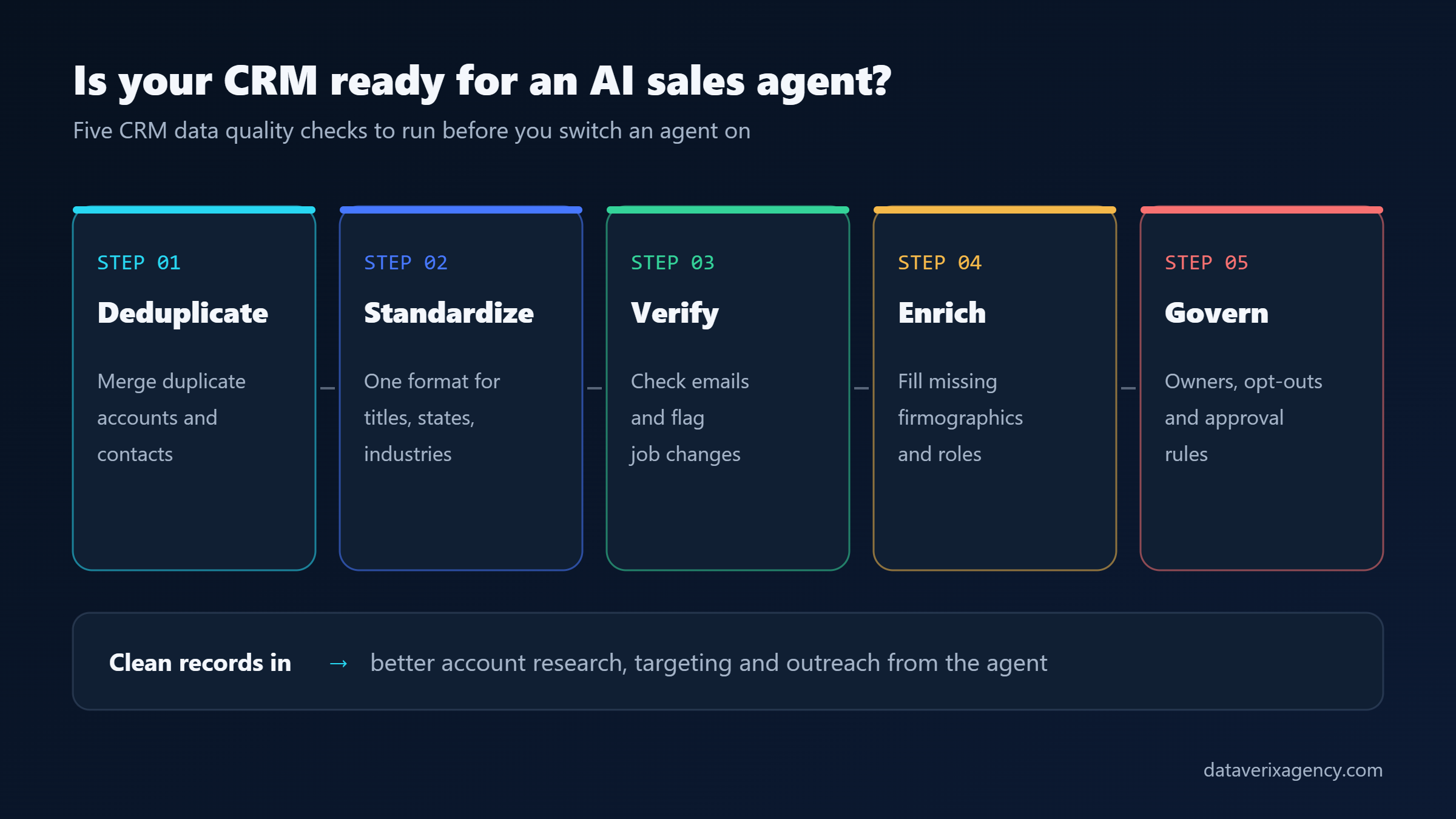
Run five checks in order: deduplicate, standardize, verify, enrich and govern. Each one removes a specific way an agent can go wrong.
1. Deduplicate accounts and contacts
Merge duplicate company records first, then contacts. Match on website domain for companies and on business email for people, not on name alone. Duplicates are the most common reason one prospect gets contacted twice by different reps or tools.
2. Standardize key fields
Pick one format for job titles, seniority, industry, state and country, and convert existing values to it. “VP Sales,” “Vice President, Sales” and “vp of sales” should land in the same bucket, or the agent’s targeting filters will miss people.
3. Verify emails and flag job changes
Run business emails through a verification tool and mark each result (valid, invalid, catch-all, unknown). Then check whether key contacts still hold the role you have on file. Our guide to lowering your email bounce rate explains why stale addresses hurt sender reputation.
4. Enrich missing fields
Fill the gaps that drive targeting: company size, industry, location, decision-maker role and LinkedIn URL. Record where each value came from and when. If you are new to this, start with what B2B data enrichment is and how it works.
5. Govern: owners, opt-outs and approvals
Make sure every account has an owner, every opt-out and “do not contact” flag is stored in a field the agent respects, and approval rules match how much autonomy you want to give it.
What CRM data hygiene best practices keep records clean after launch?
Clean once, then keep it clean with a light routine. An agent that creates and updates records can also create new mess if nobody checks its work.
- Review agent-created records weekly for duplicates and missing fields.
- Re-verify active outreach lists before each new campaign, not once a year.
- Keep a source and date field on enriched data so you know what is aging.
- Lock critical fields (owner, opt-out, lifecycle stage) so only approved users or rules can change them.
For a fuller routine, see our 10-step CRM data cleansing checklist for small sales teams.
Is an AI sales agent right for a small business?
It can be, if your CRM is in good shape and you keep a human in the approval loop. If your database is small, outdated or inconsistent, fixing the data usually delivers more value first than adding automation on top.
A practical test: pull 50 random contacts and check how many have a valid email, a current title and a correct company. If you find frequent problems, an agent will scale those problems. Our CRM data cleansing service and B2B data enrichment service are built for exactly this preparation, and our email finding and verification service covers step three.
Also check your outreach rules. Commercial email to business contacts in the US is covered by the CAN-SPAM Act; the FTC’s CAN-SPAM compliance guide for business says the law makes no exception for business-to-business email, whether a person or an agent sends it. This is general information, not legal advice.
Related: what the FCC’s new TCPA revocation of consent rules mean for B2B — if your AI agents call or text prospects, opt-outs must flow into one shared suppression list.
Related: How to choose a B2B data provider in the AI-agent era — what to check before AI agents start pulling vendor data into your CRM.
Frequently asked questions
What is CRM data quality?
CRM data quality describes how accurate, complete, consistent and current the records in your CRM are. High-quality records have one entry per company and person, standardized fields, verified business emails, current job titles and clear opt-out flags, so sales tools and AI agents can rely on them.
When is Salesforce Hunter available?
Salesforce’s September 2026 announcement lists Hunter as in pilot with general availability in November 2026. Pricing was not published in the sources we reviewed. Check Salesforce’s official pages or your account team for current availability, edition requirements and pricing before planning a rollout.
Does outside data from ZoomInfo or Apollo fix a messy CRM?
No. Third-party data can fill gaps and add signals, but it does not merge your duplicates, correct your owner assignments or record the opt-outs your team collected. Clean your own records first, then decide how outside data should update them so it does not create new duplicates.
How often should a small business clean its CRM?
Do a full cleanup before launching any automation, then run a light review monthly and re-verify contacts before each campaign. Business contact data changes as people switch jobs and companies move, so cleaning is an ongoing routine rather than a one-time project.
Get your CRM ready before the agent arrives
AI sales agents reward clean data and amplify messy data. If you want help deduplicating, verifying and enriching your records before you switch one on, request a free data sample and tell us what your CRM looks like today.
Cover photo: MART PRODUCTION on Pexels.
Founder of Dataverix. Farrukh specializes in B2B lead generation, decision-maker research and contact data enrichment, helping US businesses turn fragmented information into structured, sales-ready prospect data.
Meet the founder Upwork profile ↗farrukh@dataverixagency.com