TCPA Revocation of Consent: What the New FCC Rule Means for B2B
New TCPA revocation of consent rules take effect November 25, 2026. Here is what B2B teams that call or text prospects should change now.
 Farrukh R.Founder, Dataverix · 7 min read

KEY TAKEAWAYS
- New TCPA revocation of consent rules from the FCC take effect on November 25, 2026, replacing the delayed 2024 “revoke all” rule.
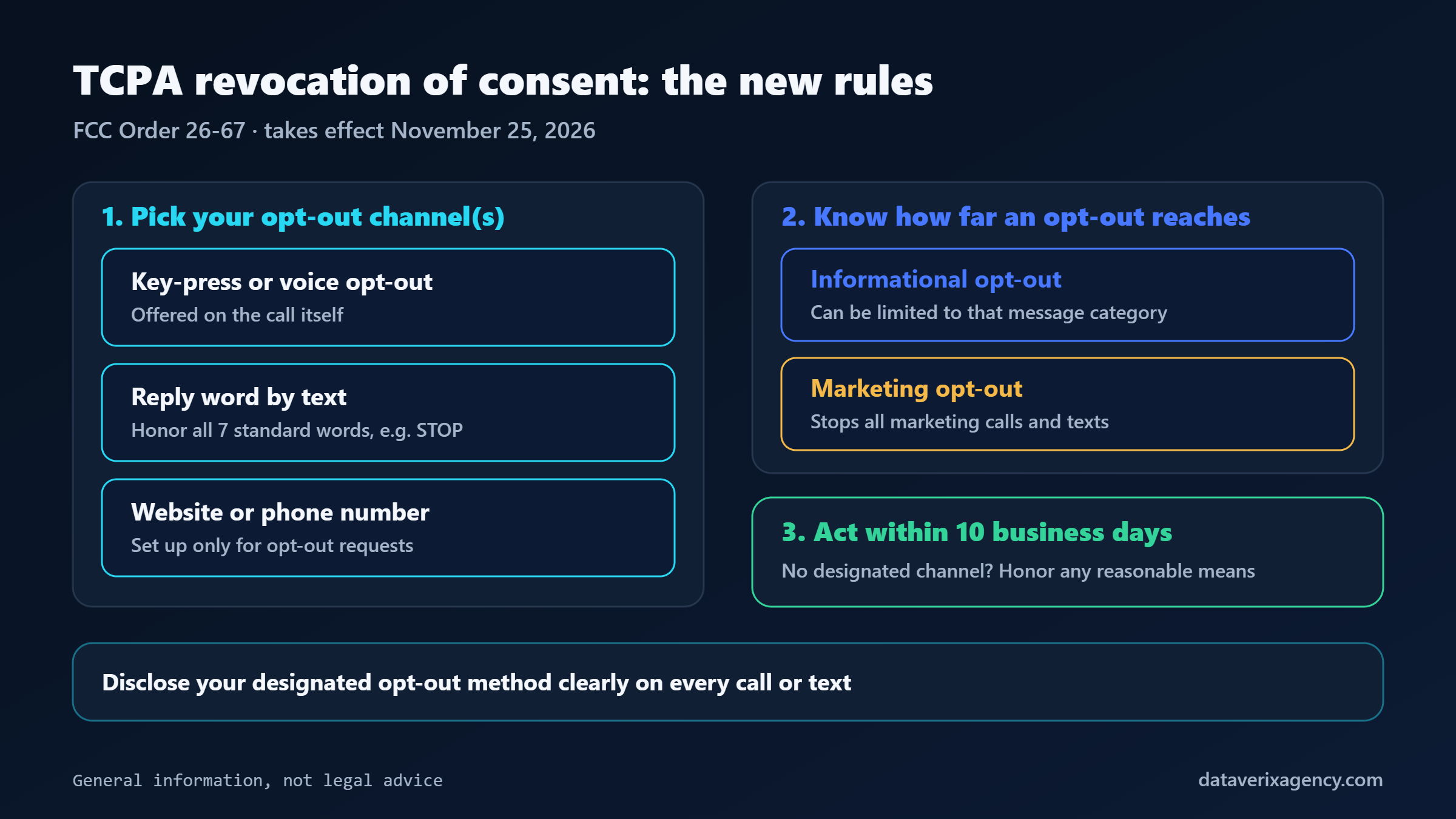
- Callers and texters may now designate one or more exclusive opt-out channels: a key-press or voice opt-out, a reply word by text, or a dedicated website or phone number, as long as they disclose it clearly on every call or text.
- A marketing opt-out still stops all of your marketing robocalls and robotexts; an opt-out from an informational message can be limited to that category.
- B2B teams are not exempt: the TCPA applies to business calling, especially to mobile numbers, so line-type data and a shared suppression list matter more than ever.
TCPA revocation of consent is changing for every business that calls or texts prospects with automated tools. In short, the FCC now lets you choose the channels people must use to opt out of your robocalls and robotexts, and it ends the strict “revoke all” approach for informational messages, but marketing opt-outs remain all-or-nothing and must still be honored within 10 business days.
The FCC adopted the order (FCC 26-67) on September 30, 2026 and released it on October 1; it was scheduled for publication in the Federal Register on October 26, 2026, and the new rules take effect on November 25, 2026. Below, we explain what changed, why it matters for B2B sales teams, and the practical steps we recommend. This is general information, not legal advice.
What is TCPA revocation of consent?
TCPA revocation of consent is the process by which a person withdraws the permission they gave a business to contact them with autodialed, prerecorded or artificial-voice calls and texts under the Telephone Consumer Protection Act (TCPA). Once consent is revoked, the business must stop those messages within a reasonable time, which the FCC caps at 10 business days.
Since 2015, people could revoke consent “in any reasonable manner,” according to DLA Piper’s October 20, 2026 analysis of the new order. That meant a “please stop” buried in an email reply or said to a rep on a call could count. The new rule gives callers a way to bring structure to that process.
What changes on November 25, 2026?
From November 25, 2026, callers may designate exclusive opt-out methods and may treat informational opt-outs as category-specific. Here is how the rules compare.
| Topic | Before | From November 25, 2026 |
|---|---|---|
| How people can opt out | Any reasonable means | You may designate one or more exclusive channels; if you designate none, any reasonable means still applies |
| Allowed exclusive channels | Not available | Key-press or voice opt-out on the call; reply text with a standard word; a dedicated website or phone number |
| Text opt-out words | Any reasonable wording | Must honor all seven words: stop, quit, end, revoke, opt out, cancel, unsubscribe |
| Informational opt-out scope | 2024 rule (delayed to January 31, 2027) would have revoked all robocalls | Can be limited to that category of informational messages |
| Marketing opt-out scope | All marketing robocalls and robotexts | Unchanged: all marketing robocalls and robotexts |
| Deadline to honor | Up to 10 business days | Up to 10 business days (FCC is considering 7) |
The disclosure requirement
Designating a channel only works if you clearly and conspicuously disclose it on the call or in the text. Per the order text and DLA Piper’s summary, burying it in online terms and conditions is not enough. For texts, including one standard word such as “STOP” satisfies the disclosure, but you must still honor all seven words.
What the FCC may change next
The same item includes a Further Notice of Proposed Rulemaking. According to Latham & Watkins’ client alert, the FCC is asking whether to shorten the deadline to seven business days, require two-way texting, require a “revoke all” option, and change how opt-outs apply across affiliates and divisions. Comments are due November 25, 2026.
Does the TCPA apply to B2B calls?
Yes. The TCPA applies to business-to-business calling, and it is strictest for calls and texts to mobile numbers. A 2023 TCPA primer on calling business phones from the National Law Review explains that autodialed calls to cell phones need consent, that prerecorded or artificial-voice marketing calls need express written consent even in B2B, and that a data vendor’s “business line” label is likely not enough proof that a number is not residential.
That matters because many small-business owners and field-based decision-makers list a personal mobile as their business number. If your sales stack uses a dialer, ringless voicemail, automated texts or an AI voice agent, these opt-out rules apply to you. The FCC confirmed in February 2024 that AI-generated voices count as “artificial” under the TCPA.
Exposure is real: statutory damages are $500 per violation and up to $1,500 for willful or knowing violations, as both DLA Piper and Latham & Watkins note.
How should B2B sales teams prepare for the new TCPA rules?
Treat this as a data and process project, not only a legal one. We recommend these steps.
- Inventory every automated channel. List each dialer, texting tool, ringless voicemail product and AI agent that touches prospects, and who owns it.
- Decide whether to designate opt-out channels. Choose from the three allowed methods, then update call scripts, IVR prompts and text templates so the disclosure appears every time.
- Build one suppression list. Opt-outs captured in your texting tool must reach your dialer, CRM and any outsourced callers. A single, shared do-not-contact field is the simplest control.
- Tag message categories. If you send informational texts, such as meeting reminders, label them separately from marketing so category-specific opt-outs work. Marketing opt-outs stay global.
- Know your line types. Flag mobile versus landline numbers in your records before they enter an automated cadence.
- Time-stamp everything. Log when each opt-out arrived and when it was processed, so you can show it was honored within 10 business days.
What does this mean for your B2B contact data?
Clean, well-labeled data is what makes opt-out compliance workable. When phone numbers lack a line type, a source or a consent status, teams cannot route them correctly, and duplicate records let an opted-out contact slip back into a sequence under a second entry.
This is where our CRM data cleansing service helps: we merge duplicates, standardize phone fields and carry suppression flags across records. Our B2B data enrichment work adds documented sources and field-level notes, and our decision-maker research focuses on direct business contact details for the right person, which reduces wasted dials. We do not provide legal advice or consent management, so pair clean data with your own counsel’s review.
For a broader cleanup plan, see our 10-step CRM data cleansing checklist. If you are adding AI calling or texting agents, our guide on preparing CRM data quality for AI sales agents covers the fields to fix first, and our guide on how to find decision-makers in a company helps you reach the right person with fewer calls.
As of November 2026, the effective date is November 25, 2026, and the FCC’s further proposals are still open for comment. Check for updates before finalizing your process.
Frequently asked questions
When do the new TCPA revocation of consent rules take effect?
The FCC’s new revocation rules take effect on November 25, 2026, 30 days after the order was published in the Federal Register. They replace the 2024 “revoke all” rule, whose effective date had been pushed to January 31, 2027. Comments on the FCC’s further proposals are due the same day.
Can a business choose how people opt out of its texts?
Yes, within limits. A business may designate a key-press or voice opt-out, a reply word by text, or a dedicated website or phone number, and it must clearly disclose that method on every call or text. Text senders must still honor all seven standard words, including stop, quit, cancel and unsubscribe.
Does a marketing opt-out stop all calls from my company?
A marketing opt-out stops all of your future marketing robocalls and robotexts to that person, not just one campaign. The new category-specific approach applies only to informational messages, such as reminders or alerts.
Is B2B cold calling exempt from the TCPA?
No. The TCPA applies to business-to-business calling. Rules are strictest for autodialed, prerecorded or artificial-voice calls and texts to mobile numbers, and Do Not Call rules can apply when a business contact’s number is residential. Manual calls to verified business landlines carry less risk. This is general information, not legal advice.
Build a cleaner, compliance-ready prospect list
New opt-out rules reward teams that know exactly what is in their data. Tell us who you want to reach, and we will show you how we structure sourced, de-duplicated records with clear phone and status fields. Request a free data sample to see the format before you commit.
Cover photo: Ron Lach on Pexels.
Founder of Dataverix. Farrukh specializes in B2B lead generation, decision-maker research and contact data enrichment, helping US businesses turn fragmented information into structured, sales-ready prospect data.
Meet the founder Upwork profile ↗farrukh@dataverixagency.com